The discovery that changed fashion forever
Few moments in fashion history have been as consequential as when 14-year-old Katherine Ann Moss was spotted at New York’s JFK Airport in 1988. Sarah Doukas, founder of Storm Model Management, noticed something special in the petite teenager from Croydon, London—a quality that would soon challenge every established beauty standard in the industry.
Born January 16, 1974, Moss possessed none of the typical supermodel attributes of the era. Standing just 5’7″ with a slight frame, she was the antithesis of the statuesque Amazonian models who dominated runways and campaigns. Yet this apparent disadvantage would become her greatest strength.
Breaking the supermodel mold
Moss’s breakthrough moment came in 1990 when photographer Corinne Day captured a series of black-and-white images for The Face magazine. The raw, unpolished photographs showed a fresh-faced Moss laughing on a beach—no glamour, no pretense. These images sent shockwaves through the fashion establishment, introducing a new aesthetic that felt revolutionary in its simplicity.
While supermodels like Cindy Crawford, Naomi Campbell, and Claudia Schiffer embodied a polished, glamorous femininity, Moss arrived offering something entirely different: vulnerability, authenticity, and an effortless cool that couldn’t be manufactured.
The Calvin Klein years and “heroin chic”
In 1992, Calvin Klein made the bold decision to feature the relatively unknown Moss in campaigns for both Calvin Klein Underwear and Calvin Klein perfumes. These minimalist, provocative images showcased Moss’s waifish figure and natural beauty, creating instant controversy and catapulting her to international fame.
The aesthetic these campaigns championed became known as “heroin chic”—a pale, thin, often androgynous look that critics claimed glamorized unhealthy body standards and drug use. Despite the backlash, Moss’s influence continued to grow, reshaping beauty ideals and creating space for different types of models in an industry previously dominated by a single standard.
Building a modeling empire
Throughout the 1990s and 2000s, Moss solidified her status as fashion royalty, working with virtually every major designer and photographer. Her versatility proved remarkable—she could embody punk rebellion for one shoot and refined elegance for another.
Her portfolio includes campaigns for Chanel, Louis Vuitton, Versace, Balenciaga, Burberry, Dior, Gucci, Dolce & Gabbana, and Alexander McQueen, among countless others. Her collaborations with photographers like Mario Testino, Steven Meisel, and Peter Lindbergh produced some of fashion’s most iconic images.
British Vogue alone has featured Moss on its cover 30 times, a testament to her enduring appeal and influence. Each appearance showcased a different facet of her chameleon-like ability to transform while remaining unmistakably herself.
Beyond modeling: Business ventures and creative direction
Unlike many models whose careers fade with youth, Moss successfully transitioned into broader creative and business roles. In 2007, she launched her first fragrance, simply named “Kate,” followed by several others. Her design collaboration with Topshop broke sales records and demonstrated her understanding of what women actually want to wear.
She’s served as a contributing fashion editor for British Vogue, designed handbags for Longchamp, created jewelry collections with Messika, and in 2022, became Creative Director for Diet Coke. These ventures showcase not just her business acumen but her deep understanding of fashion, culture, and branding.
Personal struggles and resilience
Moss’s journey hasn’t been without challenges. In 2005, British tabloid The Daily Mirror published photos allegedly showing her using cocaine, leading several brands to drop her from their campaigns. The scandal might have ended a lesser model’s career, but Moss showed remarkable resilience.
After a brief retreat from public life and reported rehab stint, she returned stronger than ever, securing new contracts and eventually doubling her income. This comeback demonstrated her extraordinary staying power and the genuine connection she had built with the fashion industry and public.
Her personal life—including relationships with Johnny Depp, Pete Doherty, and marriage to Jamie Hince—has frequently made headlines, but Moss has maintained a remarkable privacy despite her fame. She’s also mother to Lila Moss, who has followed in her footsteps as a model.
Style legacy and cultural impact
Beyond her modeling work, Moss’s personal style has been equally influential. Her ability to mix vintage treasures with designer pieces, high street finds with haute couture, created the template for modern eclectic dressing. The “Kate Moss effect” extends to her off-duty looks—skinny jeans, ballet flats, tailored blazers over simple tees—which have been just as copied as her editorial styling.
Her impact reaches far beyond fashion into music, art, and popular culture. She’s appeared in music videos for artists ranging from Elton John to The White Stripes, been name-checked in countless songs, and inspired artists like Lucian Freud, who painted a portrait of her that later sold for millions.
The enduring appeal of Kate Moss
Now in her late 40s, Moss remains a powerful force in fashion. She launched her own talent agency, Kate Moss Agency, in 2016, representing not just models but creative individuals across various disciplines. Her daughter Lila’s emerging modeling career provides another dimension to her legacy.
What explains Moss’s remarkable longevity in an industry notorious for constantly seeking the next new face? Perhaps it’s her authentic approach to fashion—she never seems to be trying too hard or following trends slavishly. Or maybe it’s her enigmatic quality—despite decades in the public eye, she rarely gives interviews, preserving an air of mystery in an oversharing age.
Whatever the explanation, Kate Moss has transcended being simply a model to become a cultural icon whose influence shows no signs of diminishing, even decades after that fateful discovery at JFK Airport.
FAQs
Who is Kate Moss in relation to Johnny Depp?
Kate Moss and Johnny Depp had a high-profile romantic relationship from 1994 to 1998. Their partnership was considered one of Hollywood’s most glamorous couples of the 1990s. Moss later testified on Depp’s behalf during his 2022 defamation trial against Amber Heard.
Is Kate Moss a millionaire?
Yes, Kate Moss is a multimillionaire with an estimated net worth exceeding $70 million. Her wealth comes from modeling contracts, business ventures, design collaborations, and her talent agency. Her business diversification has significantly increased her fortune beyond modeling earnings.
Is Kate Moss sister a model?
Yes, Kate’s younger half-sister Lottie Moss is also a model. Born in 1998, Lottie began her modeling career in 2014 and has worked with brands like Calvin Klein. While following in Kate’s footsteps, she has developed her own distinct career path.
Why do people love Kate Moss?
People love Kate Moss for her authenticity, distinctive style, and the way she challenged beauty standards. Her resilience through controversies, her enigmatic persona that maintains privacy despite fame, and her effortless cool factor have created an enduring appeal that transcends typical fashion celebrity.
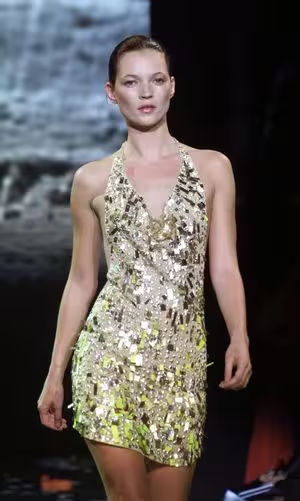
Featured image: Kate Moss, 1999. © Ken Towner—Evening Standard/Shutterstock.com, (via Britannica).