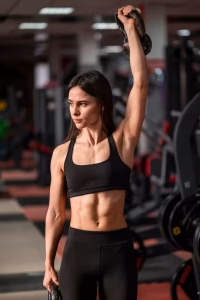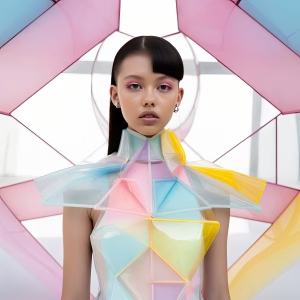
As the fashion industry navigates the rise of artificial intelligence, H&M takes a pioneering approach by creating digital twins of human models, raising important questions about the future of fashion imagery and creative professionals.
Reimagining the Fashion Model
In a move that signals a significant shift in how fashion brands create visual content, H&M has embarked on an ambitious project to develop digital replicas of real models for use in marketing campaigns and social media. The Swedish retail giant plans to create digital twins of 30 different models this year, offering a glimpse into what could become a new standard in fashion imagery production.
This initiative represents one of the industry’s most structured attempts to address the complex questions surrounding AI-generated models while still protecting the interests of human talent. Unlike previous experiments with fully artificial models, H&M’s approach directly involves the original models in the process, granting them ownership rights to their digital counterparts.
“It’s a picture of me, but it’s not me,” explained model Vilma Sjöberg about seeing her digital twin. “It was interesting how good it actually was.” This uncanny sense of familiarity yet otherness highlights the technical sophistication of today’s AI-generated imagery—so convincing that even Sjöberg’s boyfriend couldn’t distinguish between photos of the real model and her digital replica.
Looks like a collaborative approach to AI innovation in the first sight
What distinguishes H&M’s strategy is its collaborative framework. Rather than simply creating AI models independently, the company has developed a system where the actual models retain ownership of their digital twins. This arrangement allows models to control how their virtual selves are used and to negotiate compensation for that usage—including the freedom to make their digital twins available to other brands, even H&M’s competitors.
The technology behind these digital twins involves extensive photography sessions that capture models from multiple angles, in various lighting conditions, and in motion. This comprehensive approach ensures the AI can accurately represent everything from distinctive birthmarks to characteristic movement patterns, creating a virtual model that authentically reflects its human counterpart.
Jörgen Andersson, H&M’s chief creative officer, acknowledges that public response to this innovation will likely be mixed. “People will be divided. You know, ‘Is this good? Is this bad?'” he noted. Yet the company views this initiative as an opportunity to lead an important industry conversation rather than avoiding the inevitable questions AI’s rise presents to fashion.
With innovation comes responsibility
H&M’s approach appears designed to avoid the backlash that has befallen other brands experimenting with AI models. When Levi’s announced plans to use AI-generated models two years ago, the negative public reaction ultimately led the company to shelve the initiative. Similarly, Estée Lauder Companies has drawn a line at generating human imagery, limiting its AI usage to editing existing photos or visualizing ingredients.
By involving models and their agencies from the beginning and maintaining transparency about which images are AI-generated (including plans to watermark such content), H&M hopes to navigate these sensitive waters more successfully. The company views digital twins as supplements to rather than replacements for human models—potentially creating new revenue streams for models who could theoretically be “working” in multiple locations simultaneously.
Louise Lundquist, a business developer at H&M with previous experience as a model agent, explained that compensation for digital twins would follow structures similar to current arrangements for physical modeling work. The usage rights, markets, duration, and other factors would determine payment, just as they do for traditional modeling assignments.
What implications for fashion’s ecosystem does AI pose?
While H&M’s approach addresses concerns about model compensation and consent, questions remain about the broader impact on fashion’s creative ecosystem. Traditional photo shoots involve numerous professionals beyond models—photographers, makeup artists, hair stylists, wardrobe stylists, and more—whose roles could be fundamentally altered if AI-generated imagery becomes predominant.
New York-based makeup artist Mary Irwin expressed concern about the potential loss of collaboration that defines traditional fashion imagery. “This collaborative, beautiful communal process that we have in fashion and in advertising, how is it possible if we’re not all [together]?” she questioned.
Hair and makeup artist Virna Smiraldi noted that cost-cutting measures have already reduced creative team sizes in recent years, particularly since the pandemic, with some companies asking models to do their own hair and makeup. She predicts AI could accelerate this trend, potentially preserving on-set shooting only for high-end fashion while transforming production methods for mainstream brands.
The Model Alliance’s executive director Sara Ziff raised additional questions about the legal frameworks surrounding digital twins. She highlighted the importance of clear consent processes and transparent compensation structures, noting that New York’s upcoming Fashion Workers Act includes provisions specifically addressing digital replicas of models.
How is AI going to impact the future of fashion?
H&M’s experiment represents just one approach to integrating AI into fashion. Major retailers like Zara have also invested heavily in AI technology, though primarily focusing on supply chain optimization, inventory management, and trend forecasting rather than AI-generated models specifically.
Whether digital twins represent fashion’s future or merely one experimental path among many remains uncertain. Andersson believes human creative direction will remain essential, arguing that without it, AI merely recycles existing concepts rather than pushing creative boundaries.
As brands continue exploring AI’s potential, the industry faces a fundamental tension between technological efficiency and the human elements that have traditionally defined fashion’s creative processes. H&M’s digital twins project offers one potential blueprint for balancing these competing forces—acknowledging AI’s inevitability while attempting to protect the interests of the human talent that has long brought fashion imagery to life.
With the project still in its early phases, fashion professionals and consumers alike will be watching closely to see whether this approach successfully navigates the complex ethical, creative, and economic questions that ai-generated models present to an industry built on human creativity and expression.
FAQs
Does H&M use AI?
Yes, H&M uses AI extensively across its operations. Beyond its digital twins project for fashion models, the company employs artificial intelligence for inventory management, demand prediction, automated warehouses, and personalized customer experiences. Its partnership with Google Cloud focuses on developing an integrated data platform that uses machine learning and AI to optimize the entire value chain.
Does Zara use AI?
Yes, Zara has integrated AI throughout its business model, though not specifically for creating AI fashion models online. The company primarily uses artificial intelligence for trend forecasting by analyzing social media and customer data, inventory management through RFID technology, predictive analytics to anticipate customer preferences, and supply chain optimization that enables its renowned quick-response production system.
Does Dior use AI?
Dior has experimented with AI technologies in limited capacities, primarily for customer experience enhancement through virtual try-on features and personalized product recommendations. Unlike fast fashion retailers, luxury houses like Dior have generally been more conservative in adopting AI for creative processes, emphasizing traditional craftsmanship and human artistic direction in their visual content rather than ai-generated models.
Who is the most popular AI fashion model?
Currently, Shudu Gram (@shudu.gram), created by photographer Cameron-James Wilson, remains the most recognized dedicated AI fashion model, having worked with brands like Balmain and Fenty Beauty. However, the landscape is evolving rapidly with H&M’s digital twins and similar initiatives potentially creating a new category of hybrid human-AI models. These fashion models AI online represent an emerging frontier where the distinction between purely artificial and digital replicas of real models becomes increasingly significant to both brands and consumers.
Source: Business of Fashion